Food-Grade Stainless Steel Repair in Northwest Arkansas: What Plants Need to Know
By Kaden Stuart · · 3 min read
The short answer
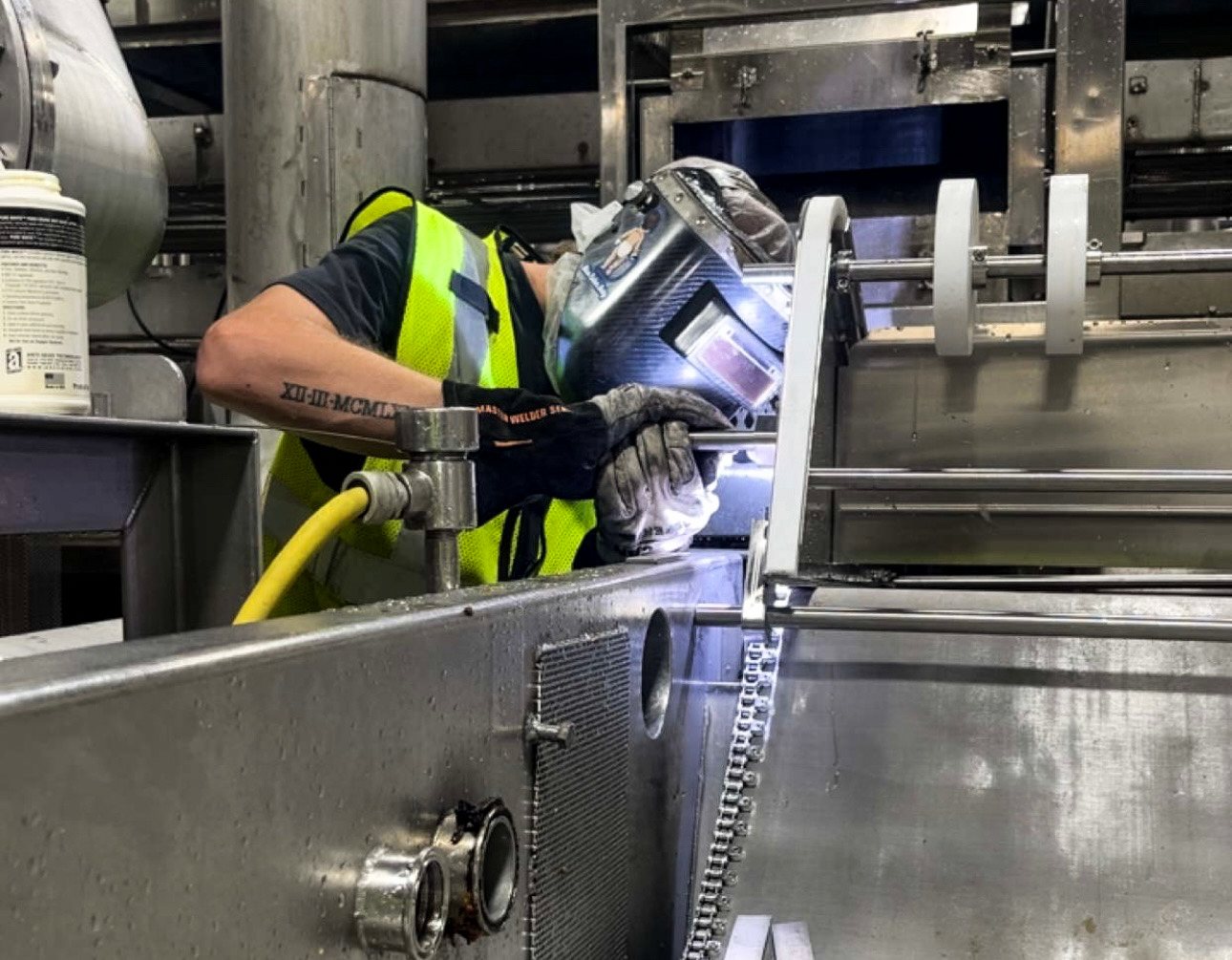
Hogeye Custom Fabrication, based in Prairie Grove, Arkansas, repairs and builds food-grade stainless steel equipment for processors across Northwest Arkansas, including conveyor frames, guards, hoppers, chutes, tanks and tube assemblies, in its shop or on site. Good food-grade work uses the right grade (304, or 316 for salty and chemical-heavy areas), smooth crevice-free welds, back-purged tube welds and passivated surfaces so the equipment stays cleanable.
Food and beverage plants run on stainless steel, and when a conveyor frame cracks, a guard gets bent or a hopper needs to be modified, the repair has to be done right the first time. Here's what plant managers and maintenance leads in Northwest Arkansas should know before hiring someone to weld on food equipment.
Who repairs food-grade stainless equipment in Northwest Arkansas?
Hogeye Custom Fabrication is a stainless steel fabrication shop in Prairie Grove, Arkansas. We repair, modify and build stainless equipment for food and beverage processors, coffee roasters, breweries and commercial kitchens across Springdale, Rogers, Fayetteville, Fort Smith and the surrounding region. Work can be done in our shop or on site at your plant.
Typical work includes:
- Conveyor frames, guards, side rails and replacement parts
- Hoppers, chutes, pans and tank modifications
- Tube and pipe assemblies, manifolds and welded ports and fittings
- Equipment stands, carts, tables and shelving
- Modifications to existing equipment built to your drawings
Should food equipment be 304 or 316 stainless?
Both are common in food processing. The right choice depends on what the steel touches and how it gets cleaned.
| Type 304 | Type 316 | |
|---|---|---|
| Typical use | General food-contact equipment, frames, tables | Wet, salty or chemical-heavy areas |
| Chloride resistance | Good | Better, thanks to added molybdenum |
| Brine, marinades, sea salt | Can pit over time | Preferred |
| Aggressive sanitizers | Usually fine with proper rinsing | More resistant |
| Cost | Lower | Higher |
When repairing existing equipment, match the original grade unless there's a reason to upgrade. Mixing grades on a repair can create weak spots where corrosion starts.
What makes a weld "sanitary"?
A weld that holds is not automatically a weld that's cleanable. On food-contact surfaces, the goal is a joint that leaves nowhere for product or bacteria to hide.
- Full fusion, no crevices. Gaps, undercut, porosity and cracks trap material. Food-contact welds should be continuous and solid.
- Smooth, flush finish. Product-contact welds are usually ground and polished to blend with the surrounding surface.
- Clean inside tube welds. Tube and pipe welds are back-purged with argon so the inside of the joint stays smooth and clean instead of rough and oxidized.
- Heat tint removed and passivated. The discoloration from welding lowers stainless steel's corrosion resistance. It has to be cleaned off and the surface passivated.
- No carbon steel contamination. Grinding wheels, brushes and tools used on regular steel leave particles that rust on stainless. Food work needs clean, dedicated tools.
How does on-site repair work in a running plant?
Taking equipment out for shop repair isn't always possible. On-site welding works when it's planned around production:
- Send photos and details first. Pictures of the damage, the equipment make and model, and any drawings help us bring the right material and tools.
- Schedule around production and sanitation. Most repairs happen during a planned shutdown, a sanitation shift or a slow line window.
- Follow the plant's procedures. Hot work permits, lockout/tagout, PPE and sanitation rules come first.
- Protect surrounding equipment. Spark and spatter control keeps nearby surfaces and product zones clean.
- Clean and release. The repaired area is cleaned and passivated as needed, then your sanitation and QA team releases the equipment before restart.
What should you send for a quote?
- Photos of the damaged or existing equipment, with something for scale
- Drawings or dimensions, if you have them
- Stainless grade, if known
- Whether the part touches product
- Your production and shutdown schedule
- Quantity, for replacement parts you want to stock
Next step
If you have a cracked frame, a part that needs replacing or a modification on the list, send photos and details and we'll tell you whether it's a shop job or an on-site repair. See our stainless steel fabrication services for the full range of work.
Ready when you are.
Request stainless repair or fabricationFrequently Asked Questions
+Who does food-grade stainless steel repair in Northwest Arkansas?
Hogeye Custom Fabrication in Prairie Grove, Arkansas repairs, modifies and fabricates food-grade stainless steel equipment for food and beverage processors across Northwest Arkansas and the surrounding region, both in its shop and on site at the plant.
+Is 304 or 316 stainless better for food processing?
Type 304 is the standard for most food-contact equipment. Type 316 adds molybdenum for better resistance to salt, brine and harsh sanitation chemicals, so it is the better choice in wet, salty or high-chloride areas.
+What makes a stainless weld sanitary?
A sanitary weld is fully fused, smooth and free of cracks, pits and crevices where product or bacteria can collect. Food-contact welds are usually ground and polished flush, tube welds are back-purged with argon to keep the inside clean, and the finished area is cleaned and passivated.
+Can a welder repair equipment inside a running food plant?
Yes, with planning. On-site work is scheduled around production and sanitation, follows the plant's hot work, lockout/tagout and sanitation procedures, and the repaired area is cleaned and released by the plant's own team before the line restarts.
Services for this project
Not ready for a quote yet?
Get new guides, design ideas and recent project photos by email. A few times a year, no spam.